Keep your SOPs current as requirements change.
Interactive Dox helps regulated teams identify changes that may affect controlled procedures, draft the proposed SOP revision, and route it through review and approval before it becomes current. The approved version stays authoritative until a person approves the change.
Controlled, current, and reviewable. Evidence as work happens.
Followed framework
requirement 4.2 revised
Disposal SOP
potentially affected
Access review
no change
Quality check
no change
Data handling
potentially affected
Training
no change
- 1Draft revision
- 2Review
- 3Approve
- ✓Current
Disposal SOP · revision 5 current · reviewed by R. Okafor · approved by M. Chen · evidence preserved
Automation should not erase the control points.
Keep the controlled SOP, the assigned roles, and the required checkpoints explicit. Let deterministic automation handle routine steps, keep AI bounded to the steps where it helps, and require a person wherever the procedure does.
- 1Start from the controlled disposal SOPControlled SOPcurrent revision
- 2Assign the operator, quality reviewer, and approverAssigned rolesassigned
- 3Check the item register and required fieldsSystemcompleted
- 4Summarize an unusual disposal note for the reviewerAI agent, bounded to summarizingnot needed
- 5Review the disposal recordQuality reviewerreviewed
- 6Give the required approval, signature-backed where configuredApproverapproved
- 7Record the evidence for the runSystemrecorded
Records kept as the work progressesIllustrative workflow: controlled disposal record
Sensitive material disposal
this run: no unusual notes
- controlled procedure referenced
- roles assigned
- register and field checks recorded
- review decision recorded
- approval recorded · signature where configured
- execution evidence kept
Illustrative configuration. Required reviews, approvals, and signatures depend on how the procedure is configured; signature steps are not a claim of Part 11 or qualified electronic signature compliance.
Efficiency, with the process still reviewable.
Controlled execution
Make responsibilities and required checkpoints explicit.
Audit readiness
Keep relevant records connected to the procedure.
Efficient AI
Avoid using model inference for deterministic work simply because AI is available.
Revision control
Preserve approved procedure history.
Reviewable changes
Proposed improvements do not silently become the new standard.
“We have a policy” isn't the same as knowing which procedure is current.
The regulated buyer needs to know the current revision, the previous one, what changed, why it changed, what superseded what, and which requirement it relates to. Not eventually. Now, and without asking around.
One current, traceable procedure.
- Sensitive material disposal · SOP-022follows: information-handling requirement
- 2Revision 2supersededJan 2025 · initial controlled version
- 3Revision 3supersededJun 2025 · disposal step added after requirement 4.1
- 4Revision 4currentMar 2026 · retention period revised, requirement 4.2 · approved M. Chen
Proposed improvements should not silently become the new standard.
When a followed framework or a procedure changes, the potentially affected procedure is surfaced as a finding, and a draft revision is proposed so the responsible person starts from a reviewable update instead of a blank page. They review, modify, accept or reject it before it becomes current. Human accountability stays central; nothing here decides legal compliance for you.
Framework changes
requirement 4.2 revised
Potentially affected procedure
Disposal SOP
Finding
attention needed
Draft revision
proposed, not applied
Human review
the responsible person
Accept or modify
or reject
Current version
revision 5
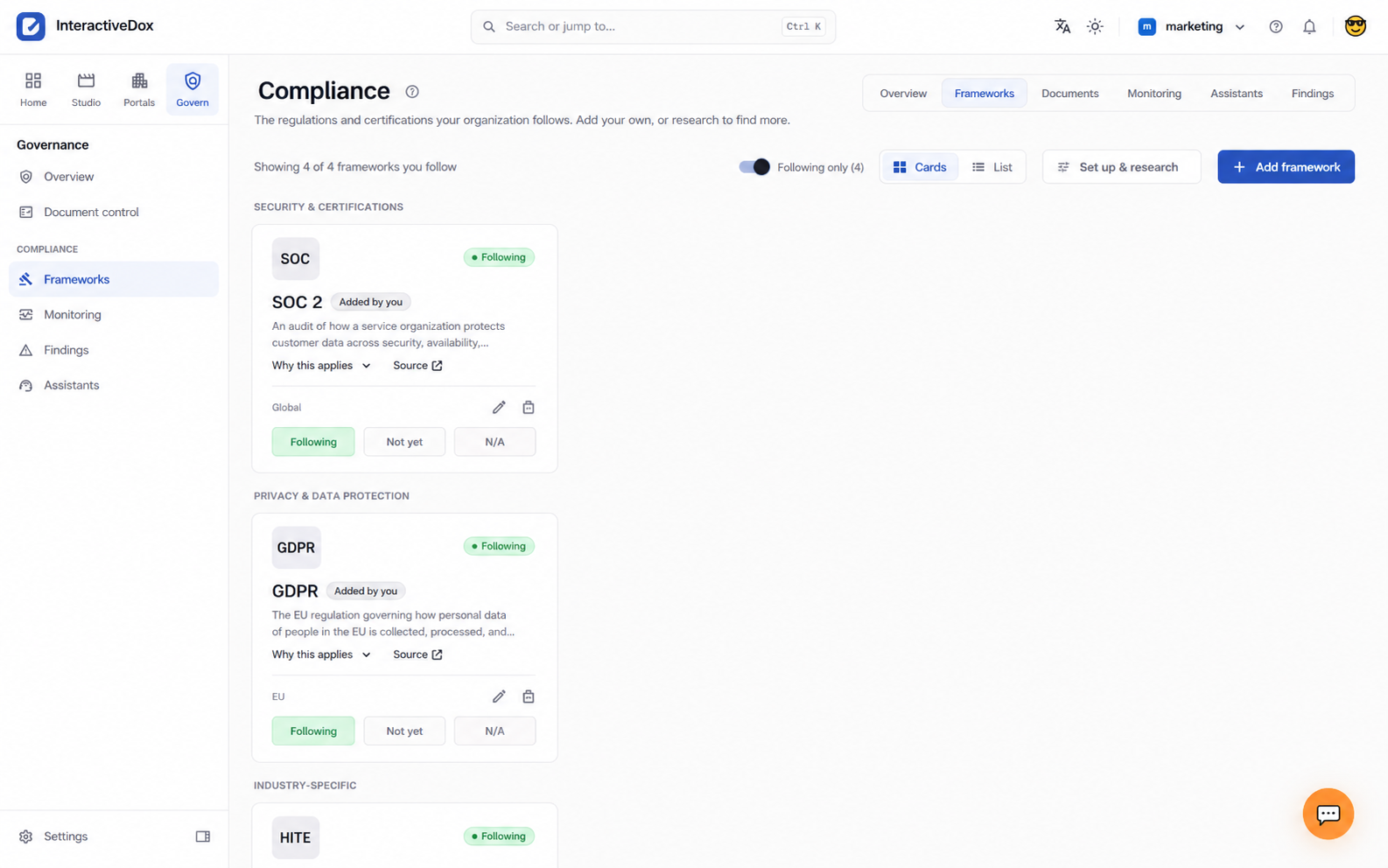
The regulations and certifications your organization actually follows, each with its category, jurisdiction and official source.
The real experience: the frameworks you follow, monitoring for change, the findings it produces, drafting against your frameworks, and a grounded assistant to investigate a requirement in the context of your own controlled documentation. Not legal advice, and never “are we compliant?”
Important changes need clear accountability.
Who reviewed this? Who approved it? When? Which revision did they approve? Route important controlled changes through review and approval where required: multi-step, multi-approver, signature-backed, time-stamped, with the revision it applies to. Not every document needs it; the ones that matter do.
- 1DraftA. Novak, Compliance · 12 Mar 2026 · 09:14
- 2ReviewR. Okafor, Quality · 13 Mar 2026 · 16:02 · 2 changes requested, resolved
- 3ApprovalM. Chen, Head of Compliance · 14 Mar 2026 · 10:47
- 4Signature-backed decisionsigned · revision 5 · authenticated approver · time-stamped
- ✓CurrentSOP-022 · revision 5 · supersedes revision 4
Illustrative record
Don't reconstruct the story during the audit.
An auditor, a regulator, a customer, a quality or risk leader, your own management: someone will ask. The desired state is that the answer isn't assembled from email and spreadsheets the week before.
The history already exists.
- 1
Framework
What requirement mattered?
- 2
Change
What changed?
- 3
Finding
Which procedure was affected?
- 4
Revision
What revision was created?
- 5
Review
Who reviewed it?
- 6
Approval
Who approved it?
- 7
Evidence
What evidence remains?
For controlled operations, without pretending one configuration fits every regulation.
- Healthcare & Life Sciences
- Financial Services & Insurance
- Manufacturing & Automotive
- Public Sector
- Other Controlled Operations
Designed to support controlled procedures and audit readiness. Interactive Dox holds no certifications, and using it does not make a workflow compliant with any regulation.
Regulated industries questions, answered.
Does Interactive Dox tell us whether we are compliant?
No. It helps you run controlled procedures with explicit roles, required checkpoints, approvals, revisions, and evidence, follow the frameworks that matter to you, and route changes through review. Compliance decisions remain yours.
Can AI steps bypass a required review or approval?
No. AI steps are bounded to their task, such as summarizing a note for a reviewer. Required reviews, approvals, and signatures stay explicit steps for a person, and the workflow waits for them.
How do we know which procedure is current?
Each controlled procedure has one current revision, the revisions it superseded, what changed and why, and who approved it. Older revisions are kept in history.
Can approvals require a signature?
Yes, where configured. Selected workflow steps can require a signature-backed decision; the signer is the authenticated approver, and the record keeps the signature, consent, timestamp, IP and user agent. This is not a claim of Part 11 or qualified electronic signature compliance.
Which frameworks does Interactive Dox support?
You follow the frameworks your organization actually follows: published standards from a searchable list, or internal requirements you define. No certification of Interactive Dox itself is claimed.
Bring one controlled procedure. Keep every control point in view.
Explore how it could run with required approvals, clear roles, efficient automation, and reviewable evidence.
Book a demo around one real SOP.
Leave your work email and we'll follow up to arrange a demo built around one of your procedures.